
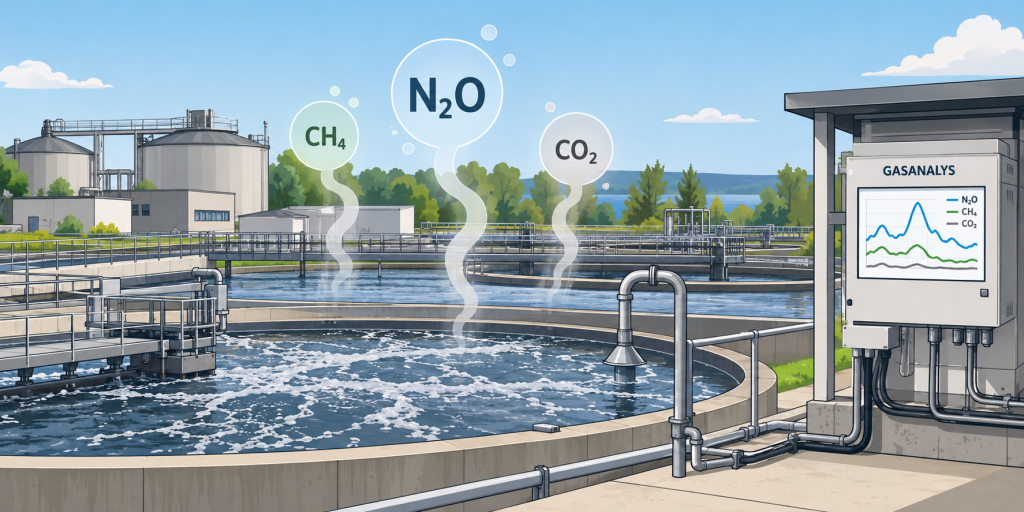
The EU’s new wastewater directive introduces changed requirements for monitoring greenhouse gas emissions from wastewater treatment plants. One of the gases covered is nitrous oxide (N₂O), which can be formed during biological nitrification and has a significant impact on the climate. For Swedish wastewater treatment plants, the directive means that emissions need to be more extensively monitored and followed up. Thus, reliable gas measurement becomes an important part of the work to document and reduce the plants’ climate impact.
What do the new regulations for N₂O at wastewater treatment plants mean?
The revised EU directive on the treatment of urban wastewater (EU) 2024/3019 came into effect on January 1, 2025. The directive contains stricter requirements for purification, energy efficiency, and monitoring of emissions, with greenhouse gases playing a more prominent role than before.
According to Article 21, emissions of greenhouse gases from wastewater treatment plants with a load of at least 10,000 person-equivalent shall be monitored. The monitoring shall include at least carbon dioxide (CO₂), methane (CH₄) and nitrous oxide (N₂O). The directive allows emissions to be determined through analysis, calculation or modelling where appropriate.
Sweden must incorporate the directive into national legislation by July 31, 2027 at the latest. Therefore, it is important to follow the detailed Swedish regulations and the application of the requirements. The Swedish Environmental Agency describes the work to implement the new wastewater directive.
Why is nitrous oxide formed in wastewater treatment plants?
Lust gas can be formed as a byproduct during biological nitrification. During the purification process, microorganisms convert nitrogen compounds through nitrification and denitrification. Depending on the process conditions, some of the nitrogen can be converted to N₂O instead of nitrous oxide (N₂).
The amount of nitrous oxide produced is influenced by factors such as oxygen availability, temperature, nitrogen loading, and the activity of microorganisms. Variations in the process can therefore lead to significant changes in emission levels.
N₂O is a powerful greenhouse gas with significantly greater climate impact per kilogram than carbon dioxide. Even relatively small emissions can therefore contribute to the treatment plant's overall climate footprint.
How can N₂O emissions be measured at wastewater treatment plants?
Measurement of nuisance gases at wastewater treatment plants can be performed using various techniques depending on the design of the facility and the purpose of the investigation. Emissions can come from several parts of the treatment process, which means that both measurement points and measurement methods need to be adapted to the operations.
One method for analyzing N₂O in the gas phase is FTIR (Fourier Transform Infrared Spectroscopy). The technique is based on infrared absorption and makes it possible to analyze several gas components simultaneously. FTIR can therefore be useful when N₂O is to be analyzed together with other relevant gases.
When measuring emissions from open pools, special sampling solutions may be required to collect and analyze the gas that leaves the water surface. To calculate the total amount of emissions, information about both gas concentration and gas flow or another representative determination of the emissions flow is needed.
The choice of technology also needs to take into account humidity, measurement range, sampling, and any interfering gas components. Read more different methods for measuring and analyzing gas.
Continuous measurement provides better understanding of emissions
The emissions of N₂O can vary significantly between different times and operating conditions. Therefore, individual measurements risk missing short-term emission peaks or changes that occur during varying loads.
With continuous emission measurement The gas concentrations can be monitored over longer periods. The results can be linked to operational data, such as oxygen content, aeration, and nitrogen load, to provide a clearer picture of when and why nitrous oxide is formed.
The measurement information can be used to identify process conditions that cause elevated emissions and to evaluate the effect of changes in operations. Continuous measurement, however, is not a general explicit requirement for all treatment plants under the new directive, as calculation and modeling can also be used where appropriate.
What do the wastewater treatment plants need to prepare for the new requirements?
For treatment plants that are affected by the directive, it will be important to create an image of where greenhouse gas emissions can occur and which methods are suitable for determining the emission levels.
This may include, among other things, mapping out possible emission sources, evaluating existing measurement capabilities, and assessing the need for additional gas analysis equipment.
According to the directive, the EU Commission must develop additional methods for measuring, estimating and modelling greenhouse gas emissions by July 2, 2027 at the latest. These will be important for how the monitoring is designed and quality assured.
For businesses that are already working to reduce their climate impact, early mapping of N₂O emissions can also provide a better basis for future process improvements.
Gas analysis and emission measurement from PPM Industrial
Reliable measurement of N₂O requires both analytical instruments and sampling systems. Which equipment is suitable depends on the measurement environment, concentration levels, and how the results are to be used.
PPM Industrial works with emission measurement and industrial gas analysis and provides analytical equipment and customized measurement systems for various types of gas measurement.
By choosing the right measurement principle and adapting the sampling system to the plant’s conditions, wastewater treatment plants can obtain reliable measurement data to map N₂O emissions, monitor process changes, and provide the basis for future reporting.