
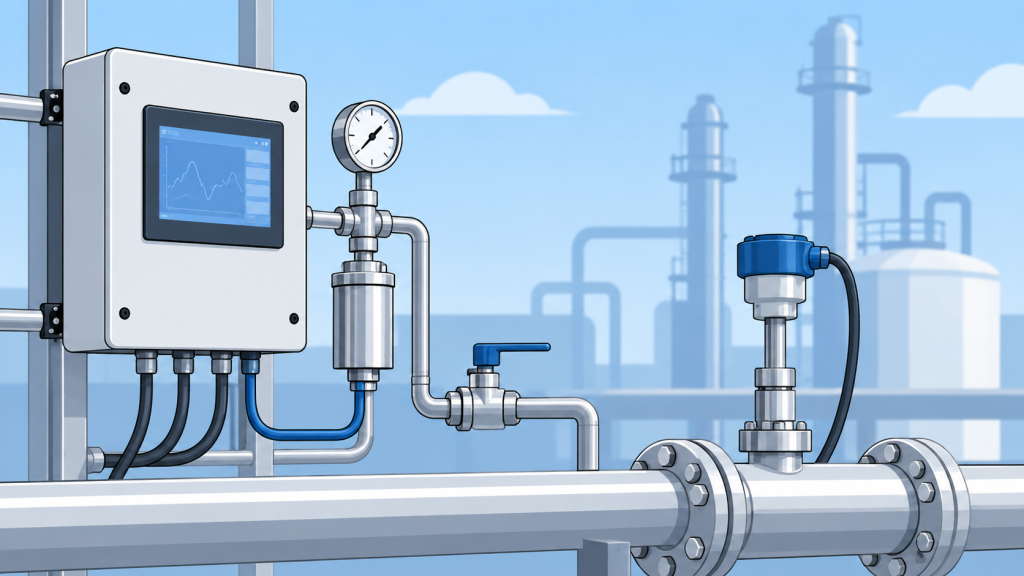
Measuring gas can involve everything from detecting a dangerous gas leak to continuously analyzing the composition of an industrial process. Which measurement method is appropriate depends, among other things, on the type of gas to be measured, the concentration, whether multiple gases are present simultaneously, and how quickly changes need to be detected.
Therefore, there is no measurement principle that suits all situations. Different types of measurement gas analysis equipment is based on different techniques, where each method has its strengths and limitations.
Electrochemical sensors
Electrochemical sensors are primarily used to measure toxic gases and oxygen. When the current gas comes into contact with the sensor, a chemical reaction occurs that generates an electrical signal. The size of the signal is used to calculate the gas concentration.
The technology is used, for example, for measuring carbon monoxide (CO), hydrogen sulfide (H₂S), ammonia (NH₃), chlorine (Cl₂) and oxygen (O₂).
Electrochemical sensors are common in both portable gas detectors and stationary gas detectors. When choosing a sensor, one needs to consider, among other things, the measurement range, lifespan, and any sensitivity to other gases in the environment.
Infrared measurement – IR and NDIR
Many gases absorb infrared light at specific wavelengths. An infrared gas analyzer can therefore determine the concentration by measuring the amount of light absorbed as it passes through the gas.
NDIR, Non-Dispersive Infrared, is used, for example, for the analysis of carbon dioxide and various hydrocarbons. The technology is well suited for continuous process monitoring because the measurement itself is performed optically and the sensor is not consumed by a chemical reaction.
PID for measuring VOCs
PID stands for Photoionisation Detector and is primarily used to detect VOCs, volatile organic compounds. The gas sample is exposed to UV light that ionizes substances with sufficient low ionization energy. The electrical signal that is then produced is used to determine the concentration.
PID instruments can measure a large number of organic substances at low concentrations and are used, among other things, in workplace environmental measurements, leak detection and the control of solvents.
An important limitation is that a standard PID cannot automatically tell exactly which substance causes the emission. If several measurable VOCs are present simultaneously, the instrument usually displays the combined response.
Catalytic measurement of combustible gases
Catalytic sensors are often used to monitor flammable gases and vapors. The gas is oxidized on a heated catalytic element, which changes the element's temperature and electrical properties. The change can then be linked to the amount of flammable gas.
The result is often expressed as a percentage of the Lower Explosive Limit (LEL). LEL describes the lowest concentration at which a flammable gas can form an ignition mixture with air. Read more What LEL is and how it is measured.
Thermal conductivity
Different gases conduct heat differently. A TCD, Thermal Conductivity Detector, takes advantage of this difference by comparing the heat transfer in the gas sample with a reference.
The method is particularly useful when the composition of the gas mixture is relatively well known and the components have clearly different thermal conductivity properties. The technique is used, among other things, in the analysis of hydrogen gas, helium and other industrial gas mixtures.
Laser spectroscopy
In more advanced process and emission analysis, laser-based techniques can be used. The principle is based on the fact that different gases absorb light at characteristic wavelengths. By directing a laser at a specific absorption region, the concentration of the specific gas can be determined.
An advantage is the high selectivity. The technology can be used for rapid and continuous analysis even when small changes in the gas concentration need to be identified.
Gas chromatography when the gas mixture needs to be separated
In some applications, knowing the total concentration is not enough; one needs to identify and quantify several different components in a gas mixture.
Gas chromatography, GC, works by passing the gas sample through a column where the substances are separated. The components then reach the detector at different times and can be analyzed individually.
The method is used, among other things, in quality control and process and gas analysis where it is important to know the composition of a gas mixture.
The sampling is also part of the measurement.
The measurement principle is only part of a complete gas system. The gas can, for example, reach the sensor through natural diffusion or be drawn in with a pump. Additionally, during process analysis, the sample may need to be filtered, cooled, heated, or otherwise treated before reaching the analyzer.
Moisture, particles, temperature, pressure and other gas components can affect the measurement result. Therefore, the right gas preparation Often an important part of the measurement system. Filters, pumps, coolers and heated sampling tubes can, for example, be used to provide the analyzer with the right conditions for the measurement.
How do you choose the right method for gas analysis?
The starting point should always be what the measurement is intended to answer. There is a big difference between warning staff about an acute gas concentration and measuring small changes in a process gas.
Some basic questions are:
- Which gas or which gases should be measured?
- Which concentration area is relevant?
- Is selective measurement of a specific gas required?
- Should the measurement be done continuously or on a sporadic basis?
- How quickly do changes need to be detected?
- Are there any moisture, particles, or other gases that could interfere with the measurement?
- Should the equipment be used portable, stationary, or integrated into a process?
By starting from these assumptions, it is possible to choose both the correct measurement principle and the correct type of measurement device. gas analysis equipment. In more complex processes, several techniques may need to be combined to provide a reliable picture of the gas composition.