
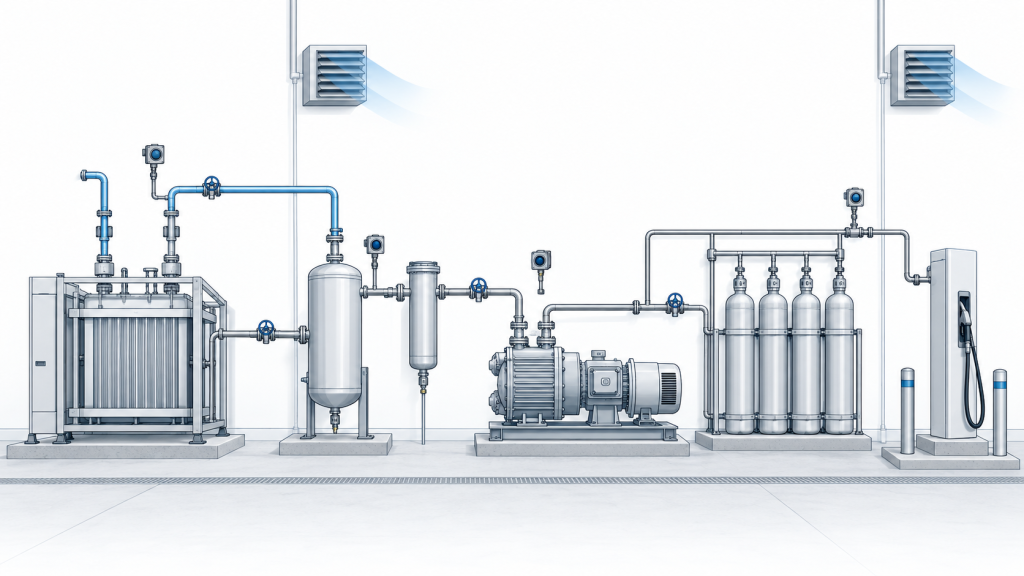
Hydrogen production places other requirements on gas monitoring unlike many traditional industrial processes. Hydrogen is colorless and odorless, very light, and has a wide range of flammability. It can also ignite at relatively low ignition temperatures. During combustion, the flame can be difficult to detect with the naked eye, especially in daylight. This means that a leak does not necessarily give any obvious warning signs before a dangerous situation has arisen.
Therefore, it is rarely enough to install a gas alarm in the area where hydrogen is produced. Instead, the gas detection needs to be designed based on the entire process: where the gas is produced, where it can leak, how it is transported, what pressures exist, how the ventilation works, and what measures should be activated if an elevated concentration is detected.
For plants that produce hydrogen through electrolysis, there is also another important aspect to consider. The process produces both hydrogen and oxygen. Safety therefore not only involves finding hydrogen that leaks into the working environment, but also being able to monitor the process itself and prevent unwanted mixing between the gases.
Why is hydrogen particularly demanding to monitor?
A property that has great practical significance is the low density of hydrogen. In the event of a minor leak, the gas will normally rise upward and can accumulate at ceilings, beams, under-ceilings, and other high-positioned areas if the ventilation system does not remove it. Therefore, the same placement of gas detectors used for propane does not necessarily work for hydrogen.
At the same time, the principle ”the higher the level, the higher the detector in the ceiling” should not be applied mechanically. A high-pressure leak can initially form a directed gas beam, and air currents from the ventilation system can change how the gas is distributed. The detectors therefore need to be placed after an risk analysis of possible leak points, ventilation flows and the geometry of the room.
The lower flammable limit of hydrogen in air is around 4 percent by volume. Gas detection should of course react before such a concentration has been established in a hazardous area. However, the alarm levels to be used should be determined based on risk assessment, applicable standards, the characteristics of the detector, and the safety features of the facility – not by using a general percentage value for all hydrogen facilities.
What gas equipment is needed for hydrogen production?
It is possible to divide the need into several functions.
| Equipment | Main function |
|---|---|
| Stationary H₂ detectors | Continuous monitoring of possible leaks and accumulations |
| Gas alarm center/control system | Receives signals and activates alarms, ventilation or safe shutdown |
| Portable gas detectors | Personal protection and control during service, maintenance and entry into risk areas |
| Gas leak detectors | Locates minor leaks in, for example, valves, connections, and pipes |
| Flame detectors for H₂ | Detects an ignited hydrogen leak |
| Spermogram | Monitors oxygen deficiency or oxygen enrichment where such risk exists |
| Process gas analysis | Controls gas composition, purity and any cross-contamination between H₂ and O₂ |
| Calibration equipment | Verifies that detectors are still measuring and sounding an alarm correctly |
| Gas preparation/sampling system | Conditioning and transporting sample gas to process analyzers |
PPM Industrials' range includes, among other things, stationary gas detectors, central units, portable gas detectors, gas leak detectors, flame detectors, gas analysis, gas preparation and calibration equipment. This makes it possible to view gas monitoring as a coherent system rather than as separate instruments.
Stationary hydrogen detection is the basic protection
Stationary gas detectors are normally the most important part of continuous monitoring. Their task is to detect a leak before the concentration develops into a dangerous level.
PPM Industrial describes the strategic placement of high leakage-risk locations as central to stationary gas detection and specifically points out hydrogen as a combustible gas where monitoring is necessary due to the risk of explosion.
In an electrolysis plant, particularly relevant control areas may be the electrolyzer and its connections, gas separators, compressors, valves, flanges, pressure control, purification and drying stages, buffer storage, gas storage, and connections to distribution or filling systems.
Even encapsulated machines and skid-built process modules need to be analyzed. A small leak inside a poorly ventilated machine room can lead to a significantly faster concentration increase than the same leak in a large open industrial space.
ISO 26142 specifically addresses stationary equipment for hydrogen detection. The standard includes requirements for precision, response time, stability, measurement range, selectivity, and sensitivity to sensor poisoning. It also describes detectors used for safety functions such as ventilation, inertization, and system shutdown.
Not all detector techniques work for hydrogen
There is an important technical pitfall here. The fact that a gas detector can measure ”combustible gases” does not automatically mean that it works for hydrogen gas.
Common infrared IR detectors for combustible hydrocarbons measure how gas molecules absorb infrared radiation. Hydrogen gas cannot be detected with conventional IR absorption in the same way. MSA explicitly points out that combustible hydrogen cannot be detected with this method and that, for example, catalytic detection can be used for H₂.
This means that when procuring goods, one needs to check which gas the current sensor is actually approved and calibrated for, Not just which product family the detector belongs to.
The choice of sensor technology is also influenced by the environment. Temperature, humidity, oxygen content, other gases, and the risk of sensor poisoning can affect the measurement. Therefore, a solution that works well in a clean electrolyzer room may not automatically be the right choice for a compressor, process vent, or outdoor installation.
The detector should not just alert – it should be able to initiate an action.
One of the most important principles in project design is to distinguish between detection and security function.
A detector detects that something has happened. The security system decides what the facility should do about it.
Depending on the risk assessment, a signal from the hydrogen detection system can, for example, trigger an optical and acoustic alarm, increase mechanical ventilation, shut down automatic gas valves, stop compressors or electrolyzers, isolate a process component, or send an alarm to the control center.
ISO 26142 explicitly addresses systems where hydrogen detection is used for example in ventilation, carbon monoxide suppression or automatic shutdown.
That is why it is often more relevant to ask ”What happens if the detector alarms?” rather than simply asking which detector should be installed.
Ventilation and gas detection must be designed together
Gas detection should not be used as a substitute for properly designed ventilation. The basic principle is instead to prevent an explosive atmosphere from ever occurring.
Since hydrogen is lighter than air, ventilation needs to be specially designed to handle high areas of the building. Ceiling pockets, beam structures, ceilings and other spaces where the gas can be trapped should be avoided or ventilated. H2Tools therefore recommends that high points and potential stagnation areas be analyzed both when designing the ventilation system and when placing detectors.
At the same time, blowers, safety valves and process valves should normally be treated as separate systems. It is not a good safety principle to use the building's regular comfort ventilation as a means of diversion for intentional hydrogen gas emissions.
Flame detection is needed where hydrogen can ignite
A gas detector and a flame detector solve two different problems.
The gas detector is trying to detect the leak before it is lit. The flame detector should detect that the combustion has already started.
The latter is particularly relevant for hydrogen because its low intensity can be very difficult to see. The Department of Energy therefore highlights special flame detection as an important safety measure in hydrogen systems.
PPM Industrial, for example, has FL500-H2, a flame detector specifically designed for hydrogen gas. It monitors the radiation from the hydrogen flame in both the UV and IR range to combine rapid response with improved resistance to false alarms.
Flame detection can be particularly relevant around electrolysers, compressors, storage systems, filling areas and other parts where a pressurized release could create a jet flame.
It is therefore not a replacement for H₂ detectors but rather an additional layer of protection.
Portable gas detectors are still needed
A stationary installation can have extensive gas detection and still need portable instruments.
When servicing, troubleshooting, maintaining, and working in confined spaces, personnel need to be able to control the atmosphere where the work is actually carried out. PPM Industrial has portable gas detectors and multi-gas detectors for mobile gas monitoring and work in, among other things, industrial environments and confined spaces.
Which sensors the instrument should contain depends on the task at hand. In a hydrogen plant, for example, there may be a need to measure both flammable gas and oxygen content.
The latter is particularly relevant when asphyxiant gas is used for inertization or purging. Nitrogen is not toxic, but can displace oxygen. Hydrogen gas can also displace air in a confined space. The AFS 2023:10 from the Swedish Working Environment Authority states that before work begins in, among other things, tanks, silos, or other environments with limited air circulation, the concentration of oxygen, hazardous substances, and flammable gases or vapors must be measured, unless the risk assessment shows that it is clearly unnecessary.
Leak detection is different from area surveillance
A stationary gas detector responds to gas that reaches the sensor. During maintenance, it is often desirable to know exactly what is present. where The gas leaves the system.
Then leak detection equipment is used.
PPM Industrial offers, among other things, portable gas leak detectors and acoustic solutions for the control of gas pipelines and the location of leaks.
This can be useful for valves, couplings, flanges, regulators, and compressors. In pressurized systems, ultrasonic or acoustic leak detection can also be interesting, as the gas flow itself through a leak point can be identified.
But again, the systems perform different functions. A leak detector for maintenance does not replace continuous safety monitoring.
Process analysis is particularly important in electroplating.
Gas detection in the premises must also be separated from process gas analysis.
In water electrolysis, hydrogen gas is produced on one side of the process and oxygen gas on the other. A key process risk is therefore that the gases are not kept sufficiently separated.
Depending on the design of the electrolyzer, there may be a need to monitor, for example, oxygen in the hydrogen stream or hydrogen in the oxygen stream. The purpose is not primarily to detect a leak in the room, but to identify a change in the process before a dangerous gas mixture is formed.
There may also be requirements for measuring product quality, such as residual oxygen, moisture or other impurities in the produced hydrogen.
PPM Industrial works with both stationary and portable gas analysis systems and also has analysers for oxygen gas as well as sampling and gas preparation equipment. This makes process analysis a natural part of the safety concept surrounding the actual gas detection.
Furthermore, the current standard exists for water electrolysis. ISO 22734-1:2025, which deals with safety requirements for systems that produce hydrogen through the electrolysis of water.
ATEX and zone classification for hydrogen production
Because hydrogen gas can form an explosive atmosphere, the ATEX regulations are central to project planning.
According to the Swedish Work Environment Authority AFS 2023:10 The employer must first investigate whether an explosive atmosphere can form. If so, a written risk assessment must be prepared. This must, among other things, address the gas’s propensity to explode, possible ignition sources, which zones may be affected, the likelihood of ignition, and possible consequences. The assessment must also cover normal operations, maintenance, and expected errors and deviations.
Subsequently, explosive gas areas are classified into zones 0, 1 or 2 depending on how frequently and for how long an explosive atmosphere is expected to occur.
The Swedish Working Environment Authority refers to SS-EN IEC 60079-10-1:2021 as a method for zoning explosive gas atmospheres. The equipment installed in each zone must then have the appropriate equipment category: category 1 in zone 0, category 1 or 2 in zone 1 and category 1, 2 or 3 in zone 2.
This means, for example, that a gas detector is not suitable solely because it can measure H₂; if it is to be installed in a classified area, its Ex-/ATEX version must also be suitable for the specific installation.
The explosion protection document ties together the safety work
AFS 2023:10 also requires the employer to establish a Explosion protection documents before work begins in an establishment where the requirements apply.
The document should, among other things, describe identified explosive hazards, zone classification, safety equipment, maintenance and temporary shutdown procedures, and handling of leaks and fires. It should also be updated when changes are made that could affect the explosive hazard.
Gas detection should therefore not be designed as a separate installation project. The placement of detectors, ventilation, emergency shut-off systems, Ex equipment, alarm systems and work procedures need to be able to be linked back to the same risk assessment.
The Swedish Work Environment Authority also sets out a clear priority order: first, one should try to prevent the formation of an explosive atmosphere, Subsequently, prevent ignition and only secondarily limit the consequences if ignition nevertheless occurs.
Gas alarms are therefore an important part of explosion protection – but not the entire explosion protection.
Permit for handling hydrogen
Hydrogen gas is considered a flammable gas and is therefore also covered by the Act on Fireable and Explosive Goods (LBE) and the MSB regulations.
For professional activities that are not public, the MSB’s current permit regulations state that up to 250 liters of flammable gas indoors respectively 1,000 liters outdoors It can be handled without permission. For gas, the volume is calculated here based on the internal volume of the containers and pipelines, not solely the amount of free gas at atmospheric pressure. If the limit is exceeded, handling is usually subject to a permit requirement.
An industrial plant for hydrogen production can therefore quickly end up within an area where the permit issue needs to be handled by the municipality or the emergency services.
It is also important to remember that the permit limit is not a safety limit. The fact that a facility is below the amount required for a permit does not mean that risk assessment, safe installation, or other relevant regulations cease to apply.
Pressurized systems are also subject to other requirements
When the hydrogen leaves the electrolyzer, it is often compressed for storage, transport or use. This adds requirements regarding pressure-bearing devices.
Containers, piping and other pressure-sensitive equipment may be subject to, among other things: AFS 2023:5 on products – pressure-bearing devices and the regulations behind the EU pressure vessel directive, PED. The requirements that apply depend, among other things, on the pressure, volume, dimensions, medium and the system's design.
In practice, a wet gas plant therefore needs to handle several regulatory areas simultaneously: flammable material, explosive atmospheres, occupational safety, electrical equipment and pressurized systems.
Calibration and functional control are part of the safety system
A gas detector that was properly installed five years ago is not automatically a functioning safety barrier today.
Sensors age. Some may be affected by other gases, pollutants, or environmental conditions. Even wiring, alarm relays, communication, and valve actuators can develop faults.
Therefore, there needs to be documented procedures for functional testing, calibration, servicing and monitoring of the entire alarm chain. IEC 60079-29-2 specifically deals with the selection, installation, use and maintenance of detectors for flammable gases and oxygen.
Therefore, it is not always enough to check that the sensor shows the correct concentration. One also needs to verify that the signal reaches the control panel, that the correct alarm is activated, and – when included in the safety function – that the ventilation, valves, or emergency stop systems actually respond as intended.
PPM Industrial works both with service and calibration and also provides calibration gases and related equipment.
A good solution relies on several independent layers of protection
The most robust gas monitoring system for hydrogen production therefore rarely consists of a single technical solution.
First, the process must be designed to prevent leaks. Then ventilation and safe bypass routes must reduce the risk of accumulation. Stationary hydrogen detectors must identify abnormalities. The control system must be able to respond. Flame detectors must detect any ignition. Portable instruments must protect personnel during maintenance and temporary operations. Process analysis must simultaneously monitor what is happening inside the actual production process.
For new electrolysis plants, the following regulations and standards are therefore particularly relevant to assess: AFS 2023:10 for explosion risk and working environment, AFS 2023:7/ATEX for equipment in an explosive environment, Regulations of LBE and MSB for the handling of flammable gas, regulations for pressure-bearing devices, and standards such as ISO 22734-1:2025, ISO/TS 15916:2026, ISO 26142 and relevant parts of IEC 60079 series.
The specific needs should then be determined through a plant-specific risk assessment. Production capacity, pressure, process design, building, ventilation, and storage volume can significantly change the requirements between two plants that on the surface produce the same gas.
Gas detection needs to be designed – not just purchased
The perhaps most important conclusion is therefore that gas equipment for hydrogen production should not be considered a purchasing list.
The question is not only which H₂ detector should be installed, but what scenario it is to detect, where the gas is expected to travel and what safety measure should be followed when it reacts.
It is only when stationary gas detection, flame detection, portable instruments, process analysis, ventilation, and control functions are designed according to the same risk profile that a cohesive safety system emerges.
PPM Industrial’s product areas in stationary and portable gas detection, leak detection, flame detection, gas analysis, gas preparation, calibration and design allow for the type of holistic solution to be built around both the actual hydrogen production and the subsequent handling.
Note: The exact detector locations, number of detectors, alarm limits, and safety features must be determined through design and risk assessment for the specific facility. The above rules are a summary and should not be used as the sole basis for design.