
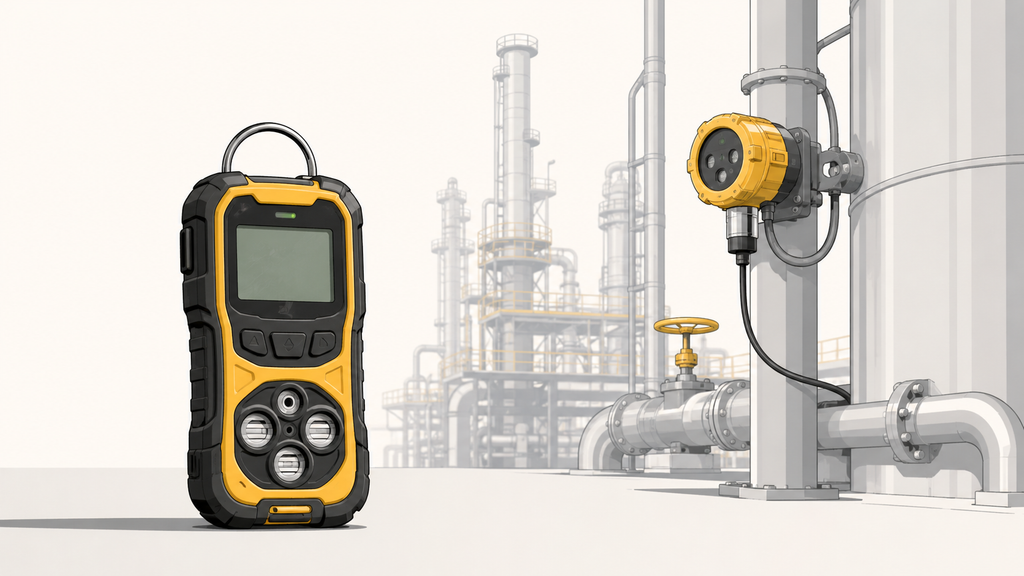
In workplaces where flammable gases or vapors may be present, it is not enough that the gas detector can measure the correct gas. The instrument must also be designed so that it One cannot become a source of light on one's own.
That is why it is used ATEX-certified gas detectors in processes such as chemical processing, petrochemicals, energy plants, wastewater treatment, tanks and other environments where an explosive atmosphere can form.
But the ATEX marking needs to be read correctly. A detector that is suitable in zone 2 is not automatically approved for zone 0.
What does ATEX mean for a gas detector?
ATEX is the EU regulatory framework for equipment and work in environments where explosive atmospheres may occur. The product requirements are based on the directive 2014/34/EU, which in Sweden has been introduced, among other things, through AFS 2023:7. The equipment must, among other things, meet relevant safety requirements, be CE-marked and have the appropriate explosion protection marking.
For one portable gas detector This means that the instrument's electrical components, battery and design must be designed so that the equipment does not risk igniting the surrounding gas mixture under the conditions for which it is certified.
This is particularly important because the gas detector is often carried around directly into the area where the gas may be present.
The zone classification determines which gas detector can be used.
Explosive areas containing gas, steam or mist are normally divided into three zones:
- Zone 0: explosive atmospheres occur continuously, persistently or frequently.
- Zone 1: An explosive atmosphere may occasionally occur during normal operation.
- Zone 2: An explosive atmosphere is not normally expected to occur and, if it does, only for a short time.
The regulations of the Swedish Work Environment Authority state that equipment category 1 must be used in zone 0, category 1 or 2 in zone 1 and category 1, 2 or 3 in zone 2.
That means that The ATEX marking itself on the gas detector must be compared with the classification plan for the working area..
A detector marked II 1G is intended, for example, for a higher level of protection than a model marked II 2G and can, provided that the other parts of the marking are correct, be used where the requirements correspond to zone 0. The EU ATEX system links category 1G to zone 0, category 2G to zone 1 and category 3G to zone 2.
This is what the labeling on a gas detector might look like
An example from PPM Industrial's range is the personal gas alarm Crowcon Gasman. Versions for toxic gas and oxygen are indicated by the marking:
II 1G Ex ia db IIC T4 Ga
The short sheet contains a lot of information about where the instrument can be used. It describes, among other things, the equipment category, explosion protection, gas group, temperature class and Equipment Protection Level, EPL. The model is also available in other versions with different ATEX classifications depending on the sensor used.
This shows why you should not choose a gas detector based solely on the product name. The certification of the specific version must be verified.
ATEX and gas measurement are two different requirements
A common misconception is that an ATEX-certified gas detector is automatically suitable for the gas to be measured.
That is not the case.
The ATEX classification primarily concerns the instrument's safety in an explosive environment. Separately from this, the detector must have the right sensor, measuring range, and performance for the gases that the operation needs to monitor.
This could for example be about:
LEL measurement for flammable gases, Oxygen measurement in the event of a risk of oxygen deficiency and the detection of toxic gases such as carbon monoxide, hydrogen sulfide, ammonia or sulfur dioxide.
A multi-gas detector can combine several of these measurements. MSA ALTAIR 5X For example, it can be equipped with up to six gases and is designated with the ATEX classification II 2G.
For simpler person monitoring, there are also one- and two-gas detectors. MSA ALTAIR 2X It is available for CO, H₂S, SO₂, NO₂, NH₃ and various combinations of toxic gases and is classified II 2G Ex ia IIC T4 Gb.
Portable or fixed ATEX gas detection?
The ATEX requirement does not only apply to hand-held instruments. Even installed gas detectors may need appropriate explosion protection when installed in classified areas.
Portable gas detectors are used primarily when personnel need to carry the protective device between different work areas or when the gas level needs to be checked before and during a work process.
Fixed gas detection is used instead of continuous monitoring of, for example, process areas, pump rooms, storage facilities, tank facilities and other locations where a gas leak needs to be detected quickly.
PPM Industrial also offers fixed explosion-proof detectors. An example is Detcon DM-700, which is a fixed detector for toxic gas with the ATEX marking II 2G Ex d ib IIB + H₂ T4 Gb.
The solution needed is therefore determined not only by the gas, but also by where the detector should be placed, how often an explosive atmosphere can occur and what function the measurement should fulfill.
The risk assessment will take place before the choice of instrument is made.
Before choosing an ATEX gas detector, the business needs to know what the actual explosion risks are.
According to the Swedish Work Environment Authority’s regulations, the employer must investigate whether an explosive atmosphere can form and, if so, carry out a written risk assessment. This must, among other things, address which substances can form an explosive atmosphere, possible ignition sources, and how the zone classification has been determined.
Only then can it be specified which gas detector is suitable.
When choosing an instrument, it is therefore necessary to check the following:
- which ATEX zone the instrument is intended to be used in
- which gas or which gases are to be detected
- gas group and temperature class
- The instrument's measuring range and alarm limits
- if diffusion or pumped sampling is required
- whether the instrument is intended to be carried on the person or installed permanently
- requirements for calibration, bump testing and documentation.
It is the combination of these factors that determines whether the gas detector is suitable for the workplace.
The right ATEX classification is part of the overall explosion protection system
An ATEX-certified gas detector does not inherently reduce the risk of an explosive atmosphere occurring. It is part of a larger safety measure.
The principle of the Swedish Working Environment Authority is that the business should primarily try to prevent the formation of an explosive atmosphere, Subsequently, prevent ignition and ultimately limit the consequences if an explosion nevertheless occurs. Furthermore, equipment and protective systems need to be checked and maintained to maintain explosion protection.
Gas detection can then be used to quickly detect dangerous concentrations and allow personnel or control systems to react.
For businesses where ATEX-classified environments exist, it is therefore important to choose a gas detector based on the classification plan, the current gas risk and the practical use – not solely based on the product being declared as ATEX-approved.