
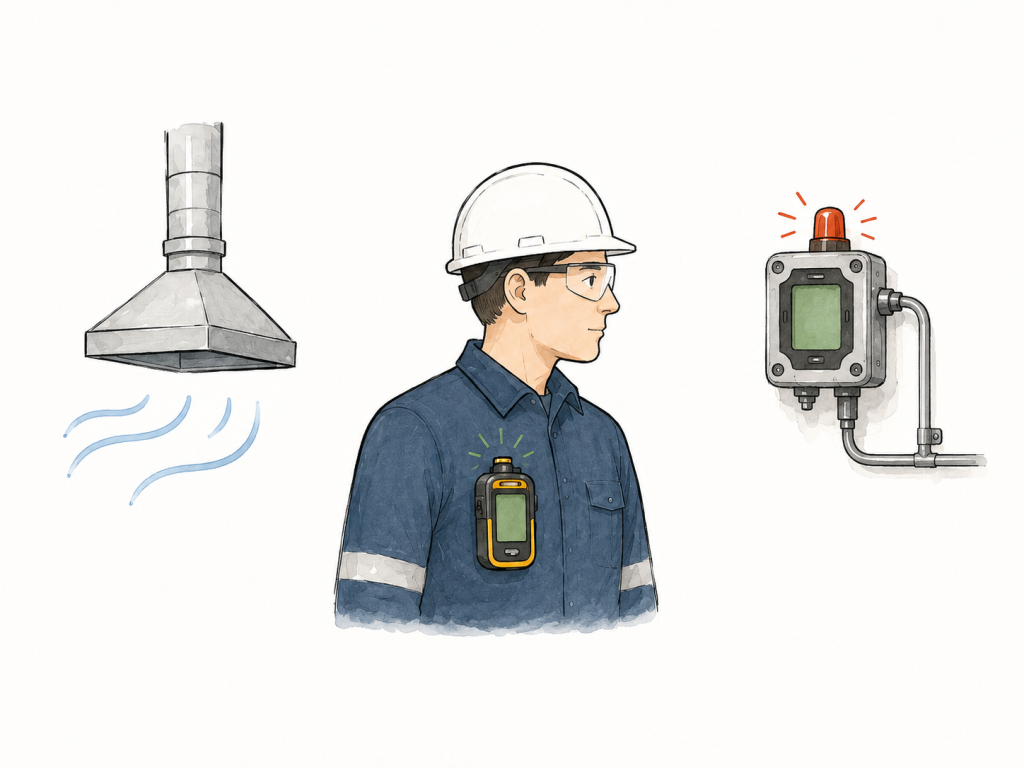
Carbon monoxide is a particularly difficult workplace hazard because the gas is neither visible nor odorous. A person can therefore be exposed to dangerous levels without realizing that something is wrong. Therefore, in workplaces where combustion occurs, safety must be based on risk assessment, effective ventilation and reliable gas detection – not on the human senses.
Carbon monoxide, CO, is formed during incomplete combustion. The risk can occur, among other places, around combustion engines, stoves, ovens, heaters, and other processes where fuel is burned. Closed or poorly ventilated environments are particularly susceptible, where the gas can accumulate.
Identify where carbon monoxide can form
The first step is to identify the work processes that can lead to carbon monoxide emissions. This could include work with motor-driven machines indoors, servicing boiler rooms, working in tunnels or other spaces with limited air circulation.
According to Rules of the Swedish Working Environment Agency The employer must investigate which chemical risk sources are handled or formed in the workplace and conduct a risk assessment before work begins. If it cannot be determined otherwise whether the air concentration is acceptable, occupational hygiene measurements may need to be carried out.
It is therefore important not to solely assess the amount of carbon monoxide that is normally produced. The risk assessment also needs to take into account, for example, operational disruptions, lack of ventilation, temporary work shifts, and situations where combustion does not function as intended.
Reduce the gas at the source
Gas detection is an important safety system, but it should not be the only measure. The basic principle is to first try to reduce the risk of carbon monoxide being released into the working environment at all.
This may mean that combustion equipment is maintained regularly, that exhaust gases are directed away from the work area, and that process ventilation is placed near the point where the contamination occurs.
The Arbetsmiljöverkets åtgärdstrappa indicates that risks should primarily be eliminated or reduced through technical and organizational measures. Process ventilation and other technical protective measures should be used before personal protective equipment becomes the primary solution.
Gas detectors detect what humans cannot feel
Because carbon monoxide cannot be detected by smell or sight, measurement equipment is needed in workplaces where the gas may be present.
Here both can portable gas detectors and Fixed-mounted gas detectors used depending on the working environment.
A personal gas detector tracks the worker and can provide an immediate alarm if the CO level around the person rises. This is particularly useful during servicing, maintenance, temporary work and work where personnel move between different risk areas. PPM Industrials' range includes portable gas detectors that can measure carbon monoxide continuously. For example, there are instruments with measurement ranges adapted for CO and alarm functions for high concentrations.
In fixed work areas, stationary detectors may be more suitable. They monitor selected measurement points continuously and can be connected to, for example, audio and light alarms or other control systems. Fixed gas detection from PPM Industrial is available for carbon monoxide with several different measurement ranges depending on the installation and the risk situation.
The placement of the detectors must be based on the risk assessment
Installing a gas detector does not automatically mean that the entire room is monitored. The sensors need to be placed where carbon monoxide can actually be present and where people could be exposed.
Considerations need to be made, among other things, regarding the gas source, ventilation, airflow, the layout of the premises, and the areas in which the staff is located.
The Swedish Working Environment Authority explicitly states that there must be an alarm system in place where risk assessments indicate that carbon monoxide levels that can cause acute poisoning may occur. The alarm system must cover the areas where such levels may occur and where people are expected to be present.
What limits apply for carbon monoxide?
AFS 2023:14 from the Swedish Working Environment Authority sets out the following hygiene limits for carbon monoxide:
- Limit value: 20 ppm or 23 mg/m³
- Short-term limit value: 100 ppm or 117 mg/m³
The exposure limit value refers to exposure during a working day of up to eight hours, while the short-term limit value for carbon monoxide refers to a period of 15 minutes.
The limit values should be part of both the risk assessment and the design of the measurement system. Therefore, it is not enough to know that carbon monoxide is present – the operations need to be able to assess it. how high the exposure is and how it changes over time.
An alarm must also lead to the appropriate action.
The gas alarm is only part of the safety chain. The staff also needs to know what to do when the alarm goes off.
There should be clear procedures for things like evacuation, shutting down equipment, ventilation, and who is allowed to reenter the area. Detectors and alarm systems also need to be checked, tested, and calibrated according to the manufacturer's instructions so that the measurement can be trusted when needed.
If work nevertheless has to be carried out when the carbon monoxide level is not acceptable, the Swedish Working Environment Authority states that a breathing apparatus with purified air should be used and that working time should be limited as much as possible.
Preventive work requires both technology and procedures
An effective protection against carbon monoxide poisoning therefore does not rely on a single product. The sources of risk need to be identified, and ventilation and processes need to be designed to limit emissions, and levels are monitored so that people can be exposed.
In workplaces where carbon monoxide can occur, fast gas detection and personal gas detectors provide important additional protection by detecting a change before it needs to be noticed in the human being.
PPM Industrial works with both portable and fixed gas detection and measurement equipment for a large number of industrial gases. The choice of sensor, measurement range, placement, and alarm solution should always be adapted to the current process and the risk assessment of the workplace.