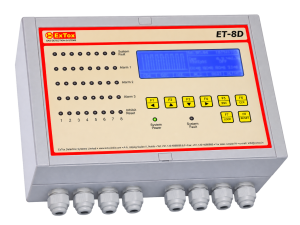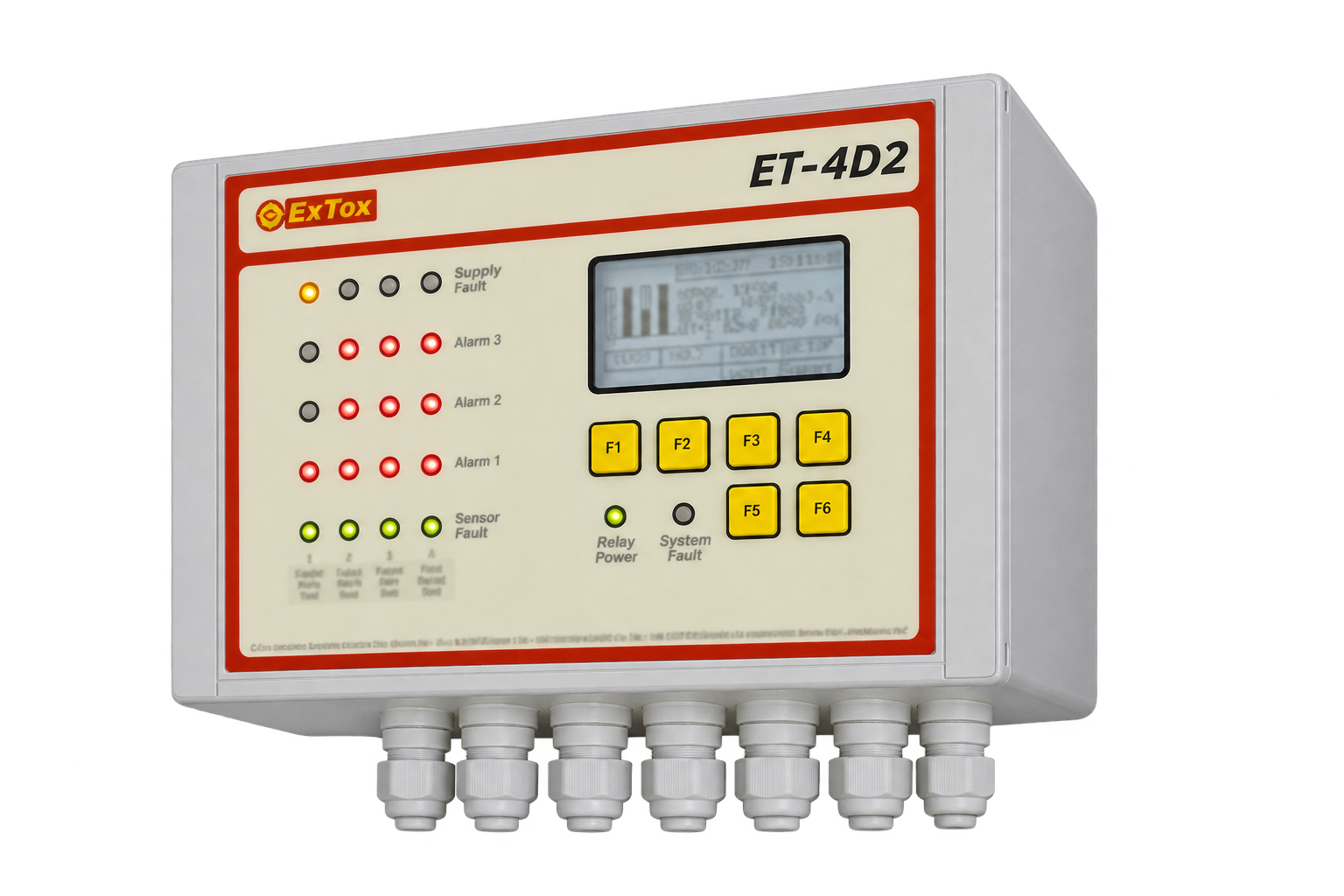
ExTox ET-4D2 – Flexible 4-channel gas alarm center
The ET-4D2 from ExTox is a compact and flexible gas alarm center developed for continuous monitoring of flammable and toxic gases as well as oxygen. The center supports up to four gas detectors and can also be configured for connection of smoke detectors.
With individually programmable alarm levels, comprehensive relay functions, and support for both analog and digital communication, the ET-4D2 is a versatile solution for stationary gas detection in industry, buildings, and process plants.
Flexible and reliable gas monitoring
The ET-4D2 is equipped with a backlit graphical display that displays current gas concentrations, alarm messages, and system status. Separate LED indicators for each channel provide the operator with a clear overview of operational status, active alarms, and any system faults.
The central unit has three individually adjustable alarm levels per channel, with the possibility of rising and falling alarms and monitoring within a defined measurement interval.
With twelve freely programmable potential-free relay outputs, external safety functions such as ventilation, magnetic valves, sound and light alarms, and process equipment can be controlled according to the needs of the operation.
Features and benefits
- Continuous monitoring of up to four gas detectors.
- Support for flammable and toxic gases as well as oxygen.
- Analog 4–20 mA inputs and digital RS485 communication.
- Possibility of connecting smoke detectors.
- Three individually programmable alarm levels per channel.
- Rising and falling alarms as well as window monitoring.
- Configurable self-activating alarm function.
- Backlit graphic display.
- Individual LED indicators for each channel.
- Twelve freely programmable potential-free relay outputs.
- Two separate relay outputs for central fault and service mode.
- Four digital inputs.
- RS232/RS485 communication with parent systems.
- Integrated service mode.
- Separate notification of acoustic alarm.
- Function for reactivating the alarm.
- Compact wall-mounted design.
- Enclosure class IP54.
System integration and alarm functions
The ET-4D2 can be used as a standalone gas alarm center or integrated with parent PLC and process monitoring systems via RS232/RS485.
The twelve programmable relay outputs can be individually configured for different alarm levels and fault indications. In addition to these, there are two separate relays for indicating central faults and active service mode.
The center's four digital inputs also enable the integration of external potential-free status signals.
Technical specifications
| Parameter | Technical specification |
|---|---|
| Manufacturers | ExTox |
| Model | ET-4D2 |
| SKU | 315000 |
| Product type | Stationary gas alarm control panel |
| Number of gas detectors | 1–4 |
| Analog inputs | 4–20 mA |
| Digital detectors | RS485 |
| Digital inputs | 4 |
| Signal processing | Microcontrollers with A/D converters |
| Display | Backlit graphic display, 160 × 80 pixels |
| Alarm levels | 3 per channel |
| Programmable relay outputs | 12 |
| Separate status relays | 2 |
| Total number of relay outputs | 14 |
| Relay type | Potentially untapped exchange opportunities |
| Relay capacity | 230 V / 5 A |
| Total rated current for programmable relays | Max. 10 A |
| Communication | RS232 / RS485 |
| Nominal supply voltage | 230 VAC |
| Power supply voltage range | 85–264 VAC or 120–340 VDC |
| Maximum power consumption | 0.2 A |
| Maximum power consumption | 45 W |
| Operating temperature | −10 to +40 °C |
| Storage temperature | −25 to +60 °C |
| Enclosure material | ABS plastic |
| Protection class | IP54 |
| Dimensions (B × H × D) | 240 × 194 × 120 mm |
| Cable penetrations | 1 × M20 and 15 × M16 |
| Mounting | Wall mounting |
Areas of application
- Industrial and process plants
- Chemical industry
- Heating plants and power stations
- Hydrogen facilities
- Battery charging stations
- Refrigeration and freezing equipment
- Laboratories
- Gas storage facilities and gas distribution centers
- Water and treatment plants
- The food industry
- Machine rooms and technical spaces
- Monitoring of oxygen content